
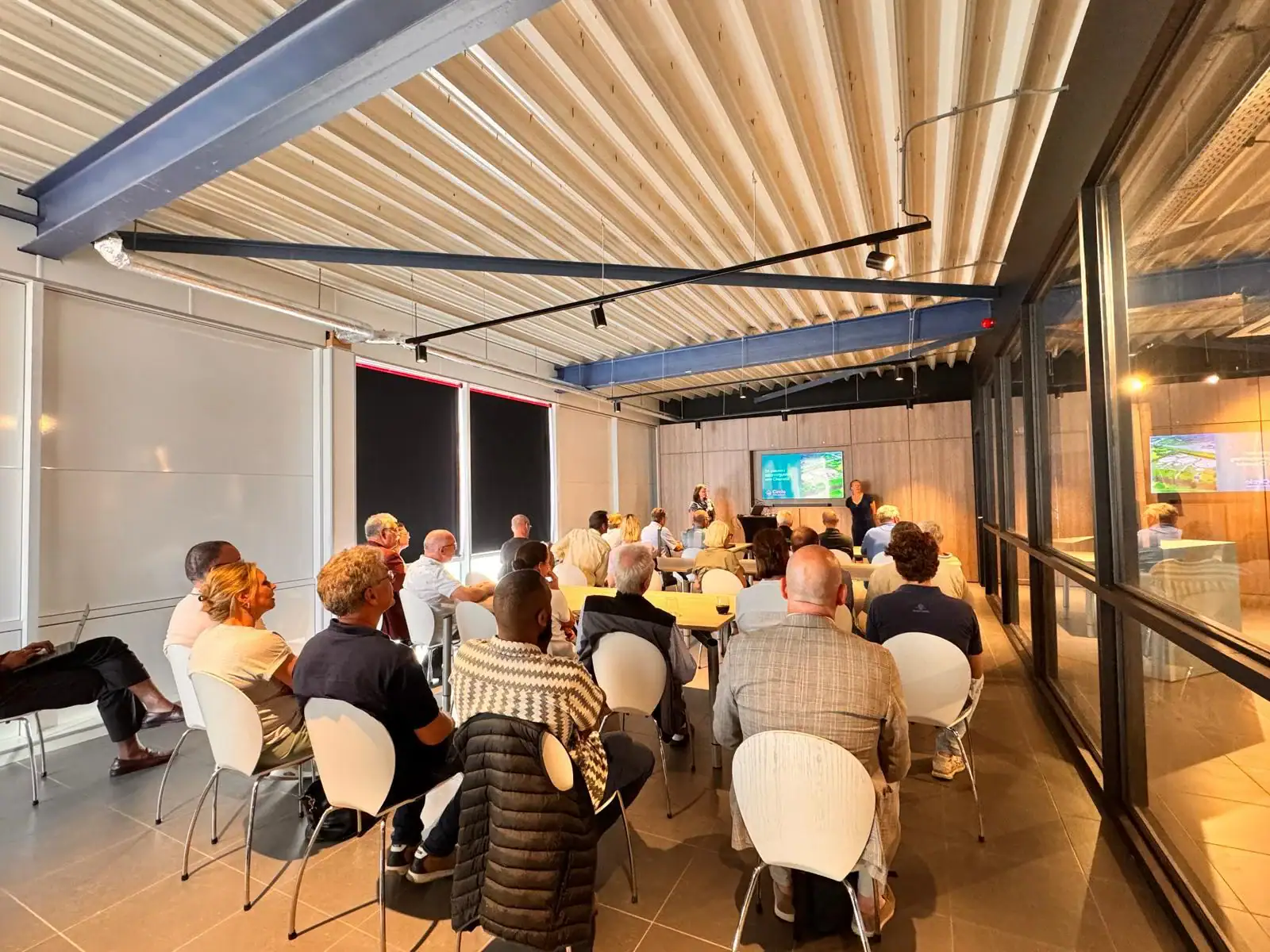
On June 17, 2026, a community dialogue took place at the Chemelot visitor center in Geleen. These dialogues are jointly organized by Chemelot, the municipality of Stein, the municipality of Sittard-Geleen, and the Province of Limburg. The goal is to inform local residents and other interested parties about developments at Chemelot.
The meeting on June 17 focused on two topics: Chemelot’s water permit, explained by Circle Infra Partners, and the arrival of the new company Reju at Chemelot. The information session on the water permit is part of the public engagement process that Circle Infra Partners has organized in preparation for the application for the new water permit.
About 30 interested parties were in attendance. They received an explanation of the water permit and were then able to ask questions during one-on-one conversations. The questions asked are listed below, along with the answers.
Q&As Following the Community Dialogue on June 17, 2026
Circle Infra Partners' effluent contains more than 600 substances. How do you know there aren't any other substances, for example, because some substances react with each other?
We don’t just look for known substances. In addition to substances we know may be present, we also regularly test the treated wastewater for unknown substances.
To this end, we use advanced analytical techniques and collaborate with specialized laboratories. If new substances are identified in the process that can be linked to Chemelot, they are evaluated and, if necessary, added to the permit.
How does Circle Infra Partners handle Substances of Very High Concern (SVHCs)?
In addition, companies that use or produce such substances must work to reduce emissions. There are regulatory plans in place for this purpose, which are periodically updated and shared with the permitting authority.
This is how we work to limit these substances and monitor their presence.
Are all substances found in the effluent listed by the RIVM, along with a standard?
If no standard is available, a careful assessment is conducted to determine what level is safe for humans, drinking water, and the environment. This is done using a national methodology and involves an evaluation by independent experts and the RIVM.
A discharge of a substance may only be authorized if it has been demonstrated that it will not have an unacceptable impact on water quality.
The discharge of substances is permitted based on the properties of each individual substance, but what is the effect of the mixture of all these substances combined?
The effluent is continuously monitored using what is known as a mussel monitor. Mussels react when water quality is poor. In addition, we regularly commission independent laboratory tests on various aquatic organisms.
This allows us to verify not only whether individual substances meet the standards, but also whether the mixture as a whole has no harmful effects.
When a factory switches to a different raw material or catalyst, is an assessment conducted to determine whether this will have a negative impact on the Integrated Wastewater Treatment Plant (IAZI)?
If a new substance is likely to end up in the wastewater, the first step is to investigate the consequences for the wastewater treatment process and for the Meuse River. An assessment is also conducted to determine whether the substance falls within the scope of the permit or whether a permit amendment is required.
A new substance may be discharged only after it has been reviewed and approved by the water board.
Who monitors the substances in the effluent?
According to the permit, Circle Infra Partners regularly takes samples (daily, weekly, and monthly) and has them analyzed for substances for which discharge standards have been agreed upon. In addition, the Limburg Water Board takes independent samples and conducts its own inspections.
As a result, there are both internal and external checks on the quality of the discharged water.
The IAZI is already outdated. Isn't there better technology available by now?
The core of the treatment process consists of living bacteria that adapt to the substances they are designed to break down. As a result, the system continues to operate very effectively. Very high removal rates are achieved for many substances.
At the same time, we continue to explore where improvements can be made and which new technologies could contribute to even better wastewater treatment in the future.
How is the changing composition of the Meuse River taken into account?
When assessing the discharge, the substances already present in the Meuse are taken into account. The assessment also takes into account situations in which little water is flowing through the Meuse. These are precisely the conditions under which substances are diluted the least.
By assuming such unfavorable scenarios, an additional safety margin is built in. The new permit also takes into account the effects of climate change.
Is Circle Infra Partners also exploring the reuse of effluent?
Reusing treated wastewater can help reduce the amount of water drawn from the Meuse River. That is why Circle Infra Partners is investigating how the effluent can be further treated so that it can be reused by companies at Chemelot.
That study is still ongoing. It also examines the residual streams generated by such an additional treatment step.
Why are you approaching the discharge primarily from the perspective of the permit rather than from the perspective of responsibility and ambition?
But our responsibility goes beyond simply complying with the permit. We continue to explore ways to further improve water quality and identify measures that are technically and economically feasible. To this end, we collaborate with research institutes and other stakeholders.
Our goal is not only to comply with today’s regulations, but also to be prepared for the stricter requirements of tomorrow.
There is a new European Drinking Water Directive. Are you taking that into account?
Although Circle Infra Partners does not produce drinking water, we do take the protection of drinking water sources into account. As part of the permitting process, an assessment is conducted to determine whether substances in the effluent pose a risk to the production of drinking water from the Meuse River.
In addition, we monitor the effluent and regularly share information with drinking water companies. This allows them to continue monitoring the quality of their sources.
Can I provide input on the new water permit?
Circle Infra Partners regularly communicates with the companies at Chemelot whose wastewater is treated. This allows us to exchange information and discuss developments that are relevant to wastewater treatment.
Dialogue with stakeholder groups (nature and environmental organizations) takes place during sessions organized by Circle Infra Partners.
Local residents and other interested parties can share their questions, concerns, and points of interest through meetings such as Chemelot’s community dialogue.
We use the feedback we receive to prepare the permit application as carefully as possible. We publish answers to frequently asked questions on our website so that everyone can review this information.